

Base layer stabilisation
Build on what's already there. Deliver more with the same budget.
A road is only as strong as its base. When the base layer fails, even a new asphalt surface cracks, ruts and breaks up, and money spent on resurfacing is lost.
Most road budgets are spent importing material or stabilising with cement and bitumen. EBS base layer stabilisation turns the locally available gravel into a strong, durable road base, so current budgets go further and roads last longer.
The engineering behind it: EBS is mixed into the existing material with a reclaimer, improving the density, tensile strength, flexibility, durability and water resistance of the sub-base or base course.
Request an Assessment See the ProcessUses local
materials
Stronger
road base
Moisture
resistant
Lower
cost
Base failure is why asphalt roads fail
Most asphalt failures don't start at the surface. They start underneath, in a weak or water-damaged base layer.
Asphalt is a thin wearing course that relies completely on the base below it for support. When that base is substandard, saturated or losing strength, the surface can't carry traffic loads: it flexes, cracks and deforms. Resurfacing or patching on a failed base only covers the problem, and the same defects return.
An alternative to cement and bitumen stabilisation
When the material on site is substandard, the traditional answer is to import better material, or stabilise it with cement or bituminous products. Both add cost, haulage and time. EBS makes the material you already have fit for purpose.
Traditional approach
- Import better gravel from elsewhere
- Stabilise with cement or bituminous products
- Higher material and haulage costs
- Fewer kilometres from the same budget
EBS base layer stabilisation
- Enhances the locally available natural gravel
- No need to import other materials
- Improved strength, flexibility and water resistance
- More road delivered from current budgets
How base layer stabilisation is achieved
| 1 | Test and design Laboratory testing of the material and mix design development. |
| 2 | Scarify The existing layer is scarified to the specified depth. |
| 3 | Check moisture In-place moisture is compared with the optimum moisture content. |
| 4 | Mix with EBS EBS is thoroughly mixed and uniformly processed with a reclaimer. |
| 5 | Shape for drainage The surface is contoured, cambered or cross-falled for drainage. |
| 6 | Compact and finish Compaction, final levels and finishing with vibratory dual drum and pneumatic tyre rollers. |

Mixing EBS into the existing material
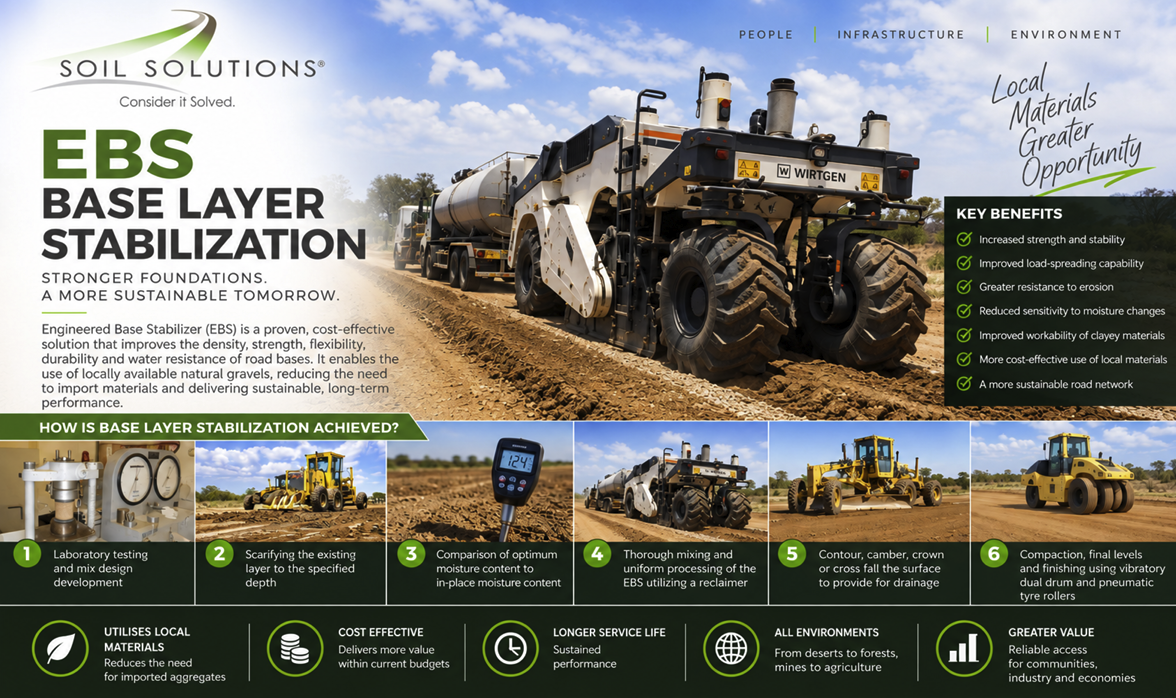
Benefits of EBS base layer stabilisation
Stronger bases. Local materials. Lower cost.
Stabilise, then seal
A stabilised base is the foundation. For gravel roads, an EBS Surface Seal then provides the hard, dust-free, water-resistant wearing course. For failing asphalt, the same stabilisation principle is used in full depth reclamation.
GRAVEL ROADS
EBS Surface Seal
Seal the stabilised road for a dust-free, all-weather surface.
ASPHALT ROADS
Asphalt rehabilitation
Recycle and stabilise failing asphalt in place with CIR or FDR.
ALL SOLUTIONS
Intelligent gravel roads
See how stabilisation fits with green roads and government programmes.
The technical detail
For engineers, specifiers and road authorities: how EBS compares, what it improves, and how each base is designed and built.
How base failure leads to asphalt failure
The asphalt layer is a wearing course; the structural capacity of the road comes from the base and subgrade beneath it.
- Water ingress: water entering through cracks, failed shoulders or poor drainage softens the base and weakens the bond between particles
- Loss of support: a weakened base deflects more under each axle load, so the asphalt above flexes beyond what it can tolerate
- Surface distress: this shows up as fatigue (alligator) cracking, rutting, potholes and edge break
- Repeated failure: surface repairs on a failed base don't restore structural capacity, so the same defects return
Lasting repair means treating the base. Where the base has failed under an asphalt road, full depth reclamation recycles the asphalt and base together and stabilises them as one stronger layer.
EBS vs traditional stabilisation
| Traditional stabilisation | EBS stabilisation | |
| Stabilising agent | Cement or bituminous products | EBS (Engineered Base Stabilizer) |
| Materials | Often depends on importing better material | Enhances locally available natural gravels |
| Layer behaviour | Rigid (cement) or bitumen-dependent | Improved flexibility (elasticity) and tensile strength |
| Moisture | Varies with binder and material | Reduced sensitivity to moisture changes |
| Cost | Higher material and haulage costs | More cost-effective use of available materials |
Properties improved
Compared with the untreated parent material, EBS improves the road base's:
- Density
- Tensile strength
- Flexibility (elasticity)
- Durability
- Water resistance
The main objective is to make locally available natural gravels suitable for pavement construction, so that other materials don't need to be imported.
Laboratory testing and mix design
Every project starts in the laboratory. The in-situ material is tested and a mix design is developed for it, setting the EBS rate and the moisture conditions for construction.
Our knowledge of material and soil mechanics lets us tailor the solution to each site, and incorporate other technologies where a specific challenge requires it.
Construction sequence
- Test and design: laboratory testing of the material and mix design development
- Scarify: the existing layer is scarified to the specified depth
- Check moisture: in-place moisture content is compared with the optimum moisture content
- Mix: EBS is thoroughly mixed and uniformly processed using a reclaimer
- Shape for drainage: the surface is contoured, cambered, crowned or cross-falled
- Compact and finish: compaction, final levels and finishing with vibratory dual drum and pneumatic tyre rollers
Application rates
| Stabilisation pass | 1.0–1.5 L/m² EBS, depending on material condition |
| Surface seal | 0.35 L/m² EBS |
| Stabilisation plus seal | 1.35–1.85 L/m² total |
Final rates are set by laboratory testing and mix design for each project.
Technical specifications
| Product | EBS (Engineered Base Stabilizer) |
| Use | Sub-base and base course stabilisation for road construction |
| Type | Eco-friendly, non-toxic, biodegradable stabiliser |
| Environment | Does not leach into the soil or water table |
| Materials | Locally available natural gravels, including clayey materials |
| Equipment | Reclaimer, vibratory dual drum and pneumatic tyre rollers |
| Design | Site-specific, based on laboratory testing and mix design |
Performance depends on material suitability, drainage, traffic and site conditions, confirmed through laboratory testing.
Make more of the material you already have
We'll test your in-situ material and develop a tailored stabilisation solution for your site.
Request an Assessment